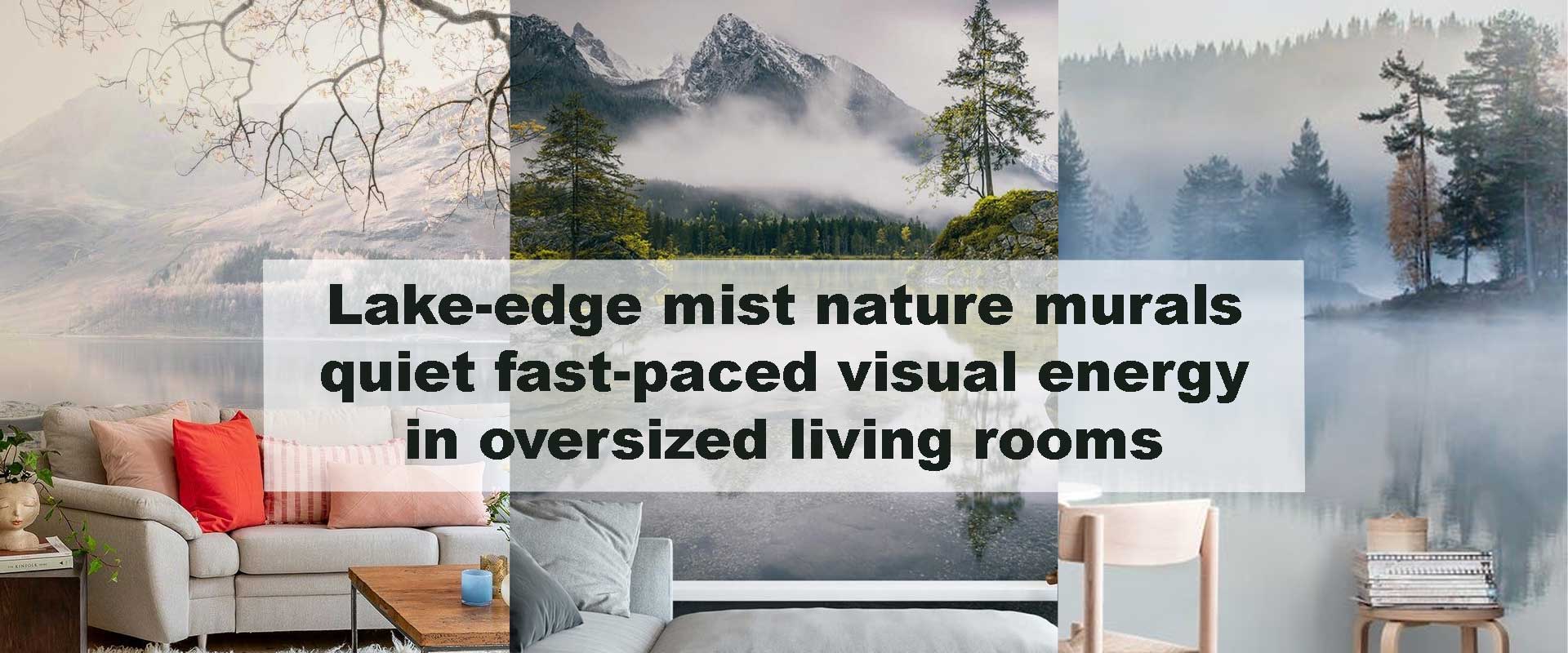
Lake-edge mist nature murals quiet fast-paced visual energy in oversized living rooms
Oversized living rooms often feel visually striking yet emotionally unsettled. Expansive walls, long sightlines, and open circulation paths can unintentionally accelerate visual movement, making the space feel louder and more restless than intended. Without a unifying surface, the eye keeps searching for balance, turning scale into stimulation rather than comfort.
Lake-edge mist nature murals introduce a quieter rhythm into these large interiors. Soft horizons, diffused reflections, and gentle tonal transitions slow perception and soften scale without diminishing presence. In living rooms that function as both social centers and everyday retreats, this approach helps visual energy settle naturally. When integrated with intention, mist-based nature wallpaper transforms openness into calm, allowing generous spaces to feel grounded, cohesive, and emotionally restorative rather than overwhelming.
Why Oversized Living Rooms Often Feel Visually Overactive
Oversized living rooms bring scale and openness, but without careful visual control, they can feel unsettled rather than serene. The sheer breadth of wall surfaces and extended sightlines creates constant motion, encouraging the eye to move quickly instead of resting comfortably. When multiple décor elements compete for attention, the space begins to feel fragmented, even if it appears minimal.
Tall ceilings, broad glazing, and open-plan circulation amplify this effect further. With few natural stopping points, the gaze sweeps continuously across surfaces, searching for visual grounding. Blank walls can feel exposed rather than calm, while high-contrast artwork accelerates visual energy. Lake-edge mist murals gently disrupt this restlessness by introducing softened horizons, layered depth, and tonal continuity that slows perception and invites the eye to settle instead of skim.
The Calming Psychology of Lake-Edge Mist Imagery
Mist-covered lake scenes trigger a sense of stillness almost immediately because they mirror how calm environments are processed by the human brain. Diffused horizons reduce visual boundaries, softened reflections eliminate sharp edges, and muted color transitions lower cognitive demand. Together, these elements reduce visual noise and allow the mind to relax within the space.
Unlike landscapes defined by dramatic peaks or dense visual complexity, lake-edge mist imagery removes urgency. There is no dominant focal point pulling attention forward, only a gradual unfolding of depth and atmosphere. This gentle progression is especially effective in expansive interiors, where overstimulation often comes from too much definition. Designers frequently point to this quality when favoring Forest nature wallpaper with softened layering over sharply detailed scenes, as subtle depth supports calm without sacrificing presence.
How Mist Murals Slow Visual Movement Across Large Walls
Large wall surfaces naturally accelerate eye movement when patterns repeat too sharply or color changes occur too abruptly. The eye begins to skim rather than settle, creating a sense of constant motion across the room. Lake-edge mist murals counteract this tendency through gradual tonal shifts, layered translucency, and softened edges that guide perception more gently from one area to the next.
Instead of forcing attention toward a dominant focal point, mist-based scenes allow visual interest to disperse evenly across the surface. The gaze moves slowly, pausing within subtle transitions rather than jumping between contrasts. This creates a wall that feels expansive yet emotionally quiet, allowing furniture, lighting, and architectural elements to exist in harmony rather than competition. A similar slowing effect is explored in Nature wall mural scenes of lakeside sunrises slow the pace of busy primary bedrooms, where softened horizons ease visual urgency and encourage a calmer spatial rhythm.
Lake-Edge Mist vs High-Contrast Nature Murals
Not all nature murals produce the same emotional effect. In oversized living rooms, contrast levels play a decisive role in how energy circulates.
Visual Impact Comparison
| Design Feature | Lake-Edge Mist Murals | High-Contrast Nature Murals |
|---|---|---|
| Horizon Treatment | Soft, diffused | Sharp, defined |
| Color Transitions | Gradual, layered | Abrupt, dramatic |
| Eye Movement | Slow and continuous | Fast and segmented |
| Emotional Tone | Calm, grounding | Energetic, expressive |
| Best Use Case | Large, open living rooms | Statement accent walls |
Lake-edge mist murals excel when the goal is visual quiet rather than spectacle. This is why they often outperform dramatic mountain or canyon scenes in oversized rooms where balance matters more than impact.
Why Lake Imagery Feels Especially Balanced in Open-Plan Living Rooms
Open-plan living rooms bring together seating, dining, and circulation within a single visual sweep, which makes cohesion far more important than decoration. In these layouts, walls must act as connective tissue rather than visual dividers. When wall treatments feel too segmented or expressive, the space can quickly lose its sense of flow and emotional balance.
Lake-edge mist murals support unity through their naturally horizontal composition and softened spatial cues. The eye follows the waterline gently across zones instead of stopping abruptly, while misty reflections subtly mirror ambient light from windows and adjoining areas. This creates cohesion without relying on symmetry or repetition. Designers often gravitate toward this approach when shifting away from feature-heavy interiors toward calmer, restorative living spaces, a transition also reflected in Interior designers are leaning toward panoramic nature murals to build visual depth this year.
Color Palettes That Enhance the Mist Effect
Color determines whether a mist mural becomes a source of calm or simply another decorative surface. Soft greys, muted blues, pale greens, and warm stone tones work together to reduce visual friction, allowing the mural to blend seamlessly into the room’s overall atmosphere. These hues encourage slow visual processing, which is essential in large spaces where overstimulation can build quickly.
High-contrast elements such as stark whites or deep blacks nearby tend to interrupt this flow, pulling attention away from the mural’s layered depth. Instead, layered neutrals and gently graduated tones allow the wall to breathe and maintain continuity. This palette philosophy pairs especially well with Landscape nature wallpaper styles that emphasize distance, atmosphere, and subtle terrain rather than clearly defined landmarks or dramatic contrasts.
Lighting Choices That Preserve Visual Stillness
Lighting plays a critical role in whether lake-edge mist murals feel serene or unsettled. In oversized living rooms, restraint is far more effective than spectacle. The goal is not to spotlight the mural, but to let it quietly shape the room’s emotional tone.
Indirect lighting methods—such as wall washers, concealed coves, or softly diffused ambient sources—help maintain the mural’s softness and depth. Harsh downlights or sharply focused fixtures can fracture the mist effect, speeding up visual movement and reintroducing tension. Warm lighting temperatures between 2700K and 3000K tend to harmonize best with misty palettes, preserving atmospheric subtlety while enhancing the mural’s sense of quiet dimensionality.
Furniture Pairings That Support Calm Energy
Furniture plays a critical supporting role in preserving the mural’s sense of stillness. Low-profile seating keeps sightlines open, allowing the misted horizon to remain visually uninterrupted, while rounded silhouettes soften movement within the room. Natural textures—such as linen, light wood, boucle, or softly grained leather—extend the mural’s organic rhythm into the foreground without competing for attention.
Furniture with sharp contrasts or overly sculptural forms tends to pull focus away from the wall, fragmenting the calm the mural establishes. Tonal harmony, on the other hand, allows the lake-edge mist to function as the room’s quiet anchor. This balance is particularly effective in living rooms styled with Nature wallpaper for living room concepts that prioritize emotional comfort, slow visual pacing, and effortless cohesion over bold visual dominance.
Why Lake-Edge Mist Murals Work Better Than Minimalist Blank Walls
Minimalist blank walls are often chosen in the pursuit of calm, yet in oversized living rooms they can feel emotionally distant or unresolved. Without visual guidance, the eye continues to scan the space, creating subtle restlessness rather than ease. The absence of texture or depth leaves large walls feeling exposed instead of grounded.
Lake-edge mist murals introduce gentle structure without visual clutter. They give the eye a place to rest while maintaining openness and restraint. Rather than acting as decoration alone, these murals function as atmospheric architecture—shaping how space is felt rather than merely how it looks. This shift explains why Nature wallpaper is increasingly replacing framed artwork in large contemporary interiors, offering continuity, depth, and emotional softness in a single surface.
Placement Strategies for Oversized Living Rooms
Placement determines whether a lake-edge mist mural feels immersive or incidental. These murals perform best on walls that anchor the primary seating zone or span the longest uninterrupted surface, where the horizon line can unfold without interruption. This allows the calming effect to register fully as part of the room’s spatial rhythm.
Fragmented walls broken by doors, windows, or frequent transitions dilute the mural’s impact and disrupt visual flow. Continuous surfaces allow the mist effect to expand naturally, reinforcing calm through scale and continuity. In especially large living rooms, extending the mural slightly beyond the central wall can soften spatial edges even further, reducing the sense of visual boundaries and helping the room feel quietly expansive rather than overwhelming.
Emotional Benefits for Daily Living
Beyond visual appeal, lake-edge mist murals shape how a living room feels throughout the day. Oversized spaces often support shifting activities—conversation, relaxation, background movement—which can create emotional inconsistency if the environment feels visually restless. A mist-based mural acts as a steady emotional backdrop, providing continuity even as the room’s energy changes.
By softening contrast and reducing visual intensity, these murals gently lower arousal levels without dulling the space. The room can move naturally from lively gatherings to quieter evenings without requiring adjustments to lighting, furniture, or layout. This emotional flexibility is a key reason mist-inspired nature murals are increasingly favored in high-traffic family living rooms, where calm must coexist with daily activity.
When Lake-Edge Mist Murals May Not Be Ideal
Although highly adaptable, lake-edge mist murals are not designed to create visual tension or dramatic impact. In interiors built around bold artistic statements, high-contrast color stories, or expressive architectural gestures, their subtlety may feel restrained rather than energizing.
That said, mist murals do not require complete minimalism to succeed. When layered thoughtfully with tactile materials—such as sculptural wood elements, stone surfaces, or softly reflective metals—or paired with considered accent lighting, they can support character without sacrificing composure. In these settings, the mural becomes a stabilizing layer, allowing expressive elements to stand out while keeping the overall atmosphere grounded and cohesive.
FAQ
Do lake-edge mist murals make large living rooms feel smaller?
No. Their soft horizons and layered depth often enhance spatial openness while calming visual movement.
Are mist murals too subtle for statement interiors?
They can still act as statement walls, but their impact is emotional rather than dramatic.
What ceiling heights benefit most from mist murals?
Rooms with high ceilings benefit greatly, as the mural visually lowers and softens vertical scale.
Can these murals work with modern furniture?
Yes. Clean-lined furniture complements the mural’s softness without overpowering it.
Is this style suitable for homes with lots of natural light?
Absolutely. Natural light enhances reflection and tonal layering within mist scenes.
Final Thoughts
Lake-edge mist nature murals bring quiet authority to oversized living rooms. By slowing visual movement, softening scale, and encouraging emotional ease, they transform large spaces into grounded environments rather than echoing voids.
For homes seeking calm without minimalism, this mural style offers a refined solution—one that allows space to breathe, light to soften, and daily life to unfold at a gentler pace.