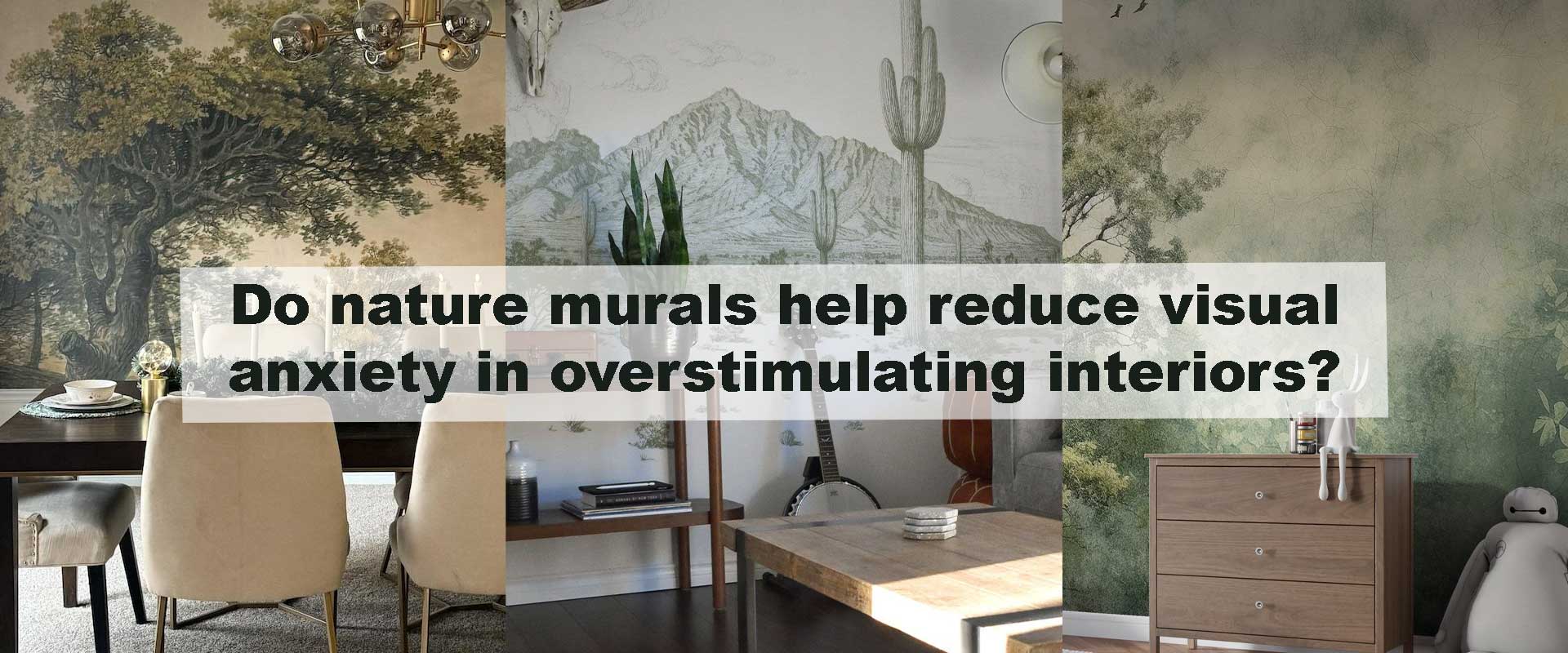
Do nature murals help reduce visual anxiety in overstimulating interiors?
Modern interiors are often filled with sharp contrasts, layered textures, artificial lighting, and constant visual input. While these choices can feel energetic at first, they frequently lead to visual fatigue over time. Nature murals offer a quieter alternative, introducing organic imagery that helps the eye slow down and the mind settle.
In spaces where overstimulation builds unconsciously, walls play a larger psychological role than many realize. A single expansive surface can either amplify tension or soften it entirely, depending on what it presents. This is where nature-inspired walls begin to shift interiors from visually demanding to emotionally grounding, especially when designed with restraint and scale in mind.
Why Visual Anxiety Builds in Contemporary Interiors
Visual anxiety rarely stems from a single poor design choice. Instead, it develops gradually when too many visual elements compete for dominance within the same space. Modern interiors often layer lighting, textures, furniture silhouettes, and decorative statements without providing the eye a clear hierarchy to follow.
Bright artificial lighting, high-contrast finishes, angular furniture, and assertive patterns place the visual system in a constant state of alert. The eye is forced to scan, refocus, and adjust continuously, which keeps the nervous system subtly activated rather than at ease. Over time, this sustained stimulation can influence emotional regulation, reduce concentration, and even disrupt restfulness without being consciously noticed.
Walls, as the largest uninterrupted surfaces in a room, play a critical role in either easing or intensifying this effect. When walls are left stark, overly reflective, or aggressively decorative, they amplify light bounce and visual noise. Instead of grounding the space, they echo existing stimulation, removing any opportunity for visual recovery.
How Nature Murals Create Visual Calm
Nature murals reduce visual anxiety by replacing sharp, fragmented visual signals with organic rhythm and continuity. Natural scenes are inherently easier for the brain to process because they mirror patterns humans have evolved alongside—layered depth, gradual transitions, and non-linear movement.
Soft gradients, distant horizons, overlapping foliage, and gentle tonal shifts give the eye permission to slow down. Rather than jumping between competing focal points, the gaze moves fluidly and predictably across the surface. This creates a sense of visual safety, similar to the calm experienced in outdoor environments where nothing demands immediate attention.
Designers often rely on Nature wallpaper to recreate this effect when real views, daylight, or greenery are limited, allowing interiors to adopt the same visual logic as open landscapes—expansive, continuous, and mentally restorative.
The Role of “Soft Focus” in Natural Imagery
One of the most powerful qualities of nature murals is their ability to remain visually present without becoming visually demanding. Unlike graphic patterns or rigid geometries that insist on attention, natural imagery supports passive engagement.
Mist-diffused forests, reflective water surfaces, and distant mountain layers create depth without sharp definition. This “soft focus” allows the eye to linger without strain, making it especially effective in rooms where people spend extended periods of time. The imagery supports presence without distraction, encouraging calm awareness rather than visual vigilance.
This effect is especially apparent in Forest nature wallpaper, where layered tree canopies and muted green tones absorb visual energy instead of reflecting it. The result is a wall that stabilizes the space—quietly anchoring the interior rather than competing within it.
Why Overstimulating Spaces Benefit the Most
Spaces that already carry heavy sensory input tend to benefit most dramatically from nature murals because they are where visual fatigue builds fastest. Urban apartments, open-plan living areas, work-focused rooms, and shared family zones often compress screens, layered lighting, décor accents, and furniture into a single visual field. When everything asks for attention at once, the eye has no clear place to settle.
In these environments, adding decorative artwork or bold patterns often worsens the issue by introducing new focal points rather than resolving existing tension. Nature murals work differently. Instead of competing with the room’s elements, they absorb visual energy and reorganize it. The wall becomes a quiet stabilizer—one continuous surface that visually holds the space together.
This mirrors how panoramic outdoor scenery calms the nervous system. When the eye encounters a wide horizon or layered natural depth, it instinctively relaxes its scanning behavior. The same effect becomes especially valuable in lower-light interiors, as discussed in Which style of nature wallpaper works best in dim-lit living rooms, where reducing visual intensity is essential for comfort rather than stimulation.
Colour Psychology and Natural Palettes
Colour choice plays a decisive role in whether a mural feels grounding or overwhelming. Nature murals typically rely on desaturated greens, softened blues, earthy neutrals, and gentle greys—tones that the eye processes with minimal effort. These hues reduce contrast fatigue and prevent sharp visual jumps, especially in rooms already filled with material variation.
Another advantage lies in how these colours interact with light. Natural palettes soften reflection and diffuse illumination, allowing spaces to transition smoothly from daylight to evening without abrupt mood shifts. Rather than feeling dramatically different at night, the room maintains emotional continuity, which is key to reducing long-term visual stress.
For interiors that already feel visually busy, Mountain nature wallpaper introduces depth through distance and layering rather than detail. Receding ridgelines and atmospheric tones expand perceived space, helping rooms feel composed and open instead of crowded or visually compressed.
Nature Murals vs Other Wall Treatments
| Wall Treatment Type | Visual Impact | Effect on Anxiety | Long-Term Comfort |
|---|---|---|---|
| Bold geometric patterns | High contrast, sharp focus | Can increase visual tension | Often feels tiring over time |
| Large framed artwork | Strong focal points | Depends on subject and scale | Can feel static or distracting |
| Plain painted walls | Neutral but flat | Minimal relief | May feel empty or cold |
| Textured feature walls | Adds depth but visual noise | Can overwhelm in busy rooms | Requires careful balance |
| Nature murals | Soft depth, organic flow | Reduces visual overload | Supports calm, adaptable spaces |
Depth Without Clutter: Why Scale Matters
Nature murals are most effective when they simplify a space rather than compete within it. Instead of layering shelves, framed art, textures, and decorative accents across a wall, a single expansive mural consolidates visual interest into one cohesive surface. This reduction in competing elements immediately lowers cognitive load, allowing the eye to settle instead of jump.
The result is visual breathing room. Depth is achieved through perspective, horizon lines, and atmospheric layering rather than physical objects. In overstimulating interiors—where furniture, lighting, and materials already activate the space—this kind of depth feels restorative rather than demanding. The wall recedes visually, creating calm without emptiness.
In compact or high-density layouts, designers often lean toward Landscape nature wallpaper because wide horizons stretch perceived boundaries. Even when square footage is limited, distant scenery introduces openness while preserving softness, helping rooms feel composed instead of compressed.
Lighting Interaction and Visual Ease
Lighting plays a decisive role in whether a mural soothes or overstimulates. Unlike glossy finishes or high-contrast wall treatments, nature murals tend to absorb and diffuse light gently. This soft interaction reduces glare, blurs hard shadows, and prevents the sharp visual edges that can cause fatigue—especially after sunset.
As lighting shifts throughout the day, natural imagery adapts gracefully. Warm or neutral illumination enhances tonal transitions within the mural, keeping the space emotionally consistent from morning through evening. This continuity prevents the abrupt mood changes that often occur when artificial lighting clashes with reflective or highly saturated surfaces.
This relationship between light and visual comfort is examined in How does lighting temperature influence the mood of nature wall murals, where even subtle adjustments are shown to shape how calm—or restless—a space ultimately feels.
Emotional Safety and Subconscious Response
Beyond surface-level aesthetics, nature murals engage something far more instinctive: a deep sense of psychological safety. Expansive landscapes, overhead tree canopies, and calm water scenes echo environments where humans historically felt protected, oriented, and supported. These visuals communicate openness without exposure, depth without threat, and continuity without interruption.
On a subconscious level, such imagery gently lowers vigilance. The eye no longer scans for contrast or disruption, allowing the nervous system to shift out of alert mode. This subtle calming response explains why nature-inspired walls increasingly appear in wellness-focused interiors, creative studios, and private living spaces—areas where overstimulation doesn’t announce itself loudly but accumulates quietly over time.
Choosing the Right Nature Mural for Anxiety Reduction
Not every nature scene delivers the same calming effect. Imagery that is dense with detail, saturated with colour, or filled with dramatic focal points can unintentionally maintain visual tension rather than relieve it. In overstimulating interiors, restraint becomes just as important as subject matter.
The most calming murals tend to share a few defining characteristics:
- Distant viewpoints that encourage visual breathing room rather than close inspection
- Limited, harmonious colour palettes that avoid sharp contrast
- Soft gradients and atmospheric layering that slow the movement of the eye
- Minimal separation between elements, allowing the scene to feel continuous rather than fragmented
In quieter, understated interiors, Watercolor nature wallpaper often performs especially well. Its diffused edges and painterly transitions reduce visual sharpness, helping walls feel present but never demanding—an ideal balance for spaces designed to soothe rather than stimulate.
FAQ
Do nature murals work in small spaces without overwhelming them?
Yes. When chosen with gentle tones and distant imagery, they often make small rooms feel more open rather than enclosed.
Can nature murals reduce visual fatigue in workspaces?
They can. Soft natural scenes help the eye recover from screen exposure and reduce mental strain during long work hours.
Are nature murals better than adding multiple plants?
They serve a different purpose. While plants add texture, murals provide continuous visual depth without maintenance or spatial clutter.
Do darker nature murals still reduce anxiety?
Yes, when contrast is controlled. Deep forests or twilight scenes can feel grounding if lighting remains soft and balanced.
Is one wall enough to create a calming effect?
In most cases, yes. A single well-placed mural often delivers more visual relief than covering multiple surfaces.
Final Thoughts
Nature murals help reduce visual anxiety by simplifying what the eye sees rather than adding more to process. In overstimulating interiors, they replace chaos with rhythm, contrast with harmony, and visual noise with depth.
By allowing walls to behave like calm landscapes instead of decorative statements, interiors become easier to inhabit emotionally. When chosen thoughtfully, nature-inspired walls don’t just soften a space visually—they change how it feels to live within it.