Nature wall murals with layered mountains make tall hallways feel endless
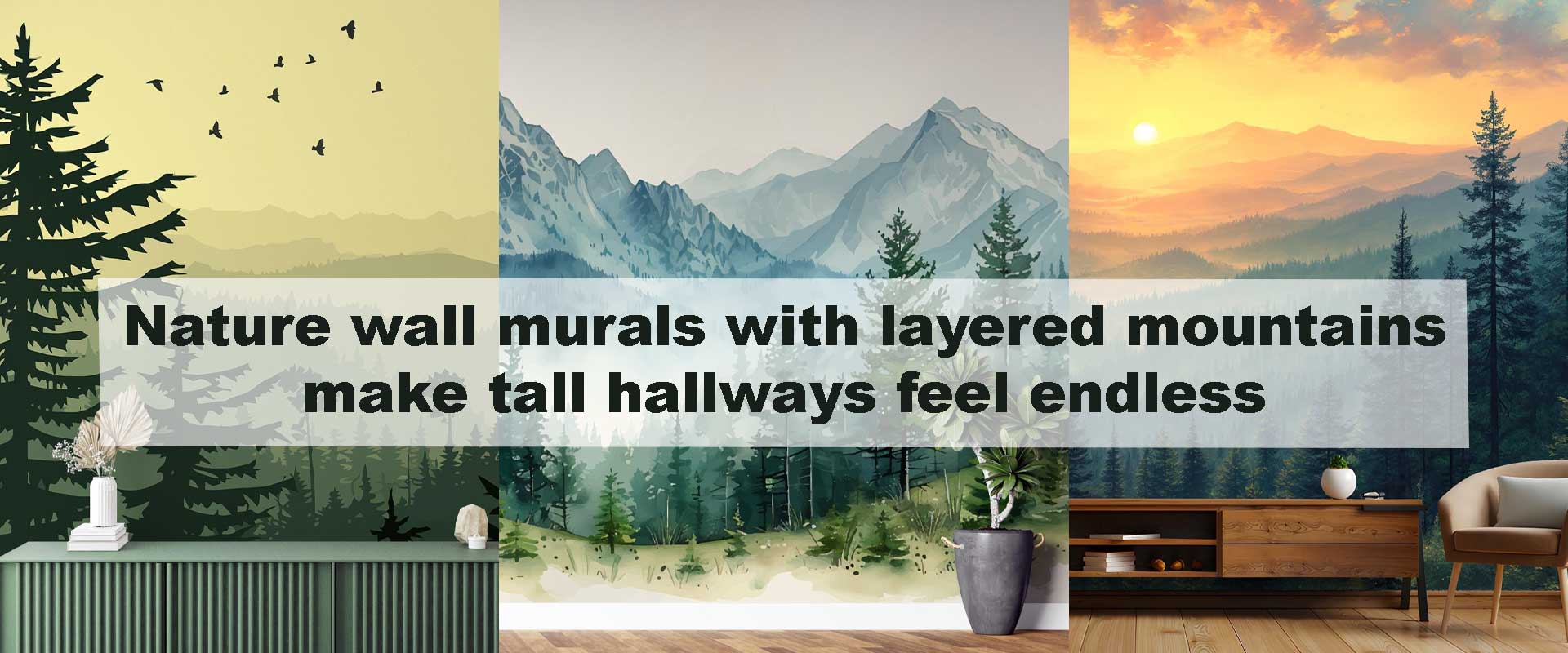
Nature wall murals with layered mountains have a unique ability to transform tall hallways into spaces that feel open, continuous, and quietly immersive. In areas where height often exaggerates emptiness and narrow proportions feel restrictive, layered mountain imagery introduces depth that softens architectural extremes. The eye follows distant ridgelines and subtle tonal shifts, allowing the wall to feel less like a boundary and more like a visual extension of the space itself.
Rather than serving as simple transition zones, tall hallways become calm passages that guide movement and mood. Through atmospheric perspective and gentle repetition, layered mountain murals create the illusion of endless flow, helping vertical corridors feel balanced, intentional, and emotionally connected to the rest of the home.
Why tall hallways often feel disconnected
Tall hallways frequently magnify architectural imbalance. Excessive height can exaggerate emptiness, while limited width makes the space feel compressed and unfinished at the same time. Without visual anchors, bare walls intensify shadows and echo, creating an atmosphere that feels colder and less welcoming than adjacent rooms.
Layered mountain murals resolve this tension by introducing horizontal motion within a vertical frame. Soft ridgelines and gradual transitions visually widen the corridor, grounding the height and restoring balance. Rather than functioning as a pass-through, the hallway gains a sense of direction and flow that feels designed rather than incidental.
The psychology behind layered mountain imagery
Mountain landscapes instinctively communicate scale, stability, and continuity. When rendered in layered compositions, they replicate atmospheric perspective—distant peaks dissolve into lighter tones while closer forms carry gentle definition. This natural visual hierarchy signals depth and openness, encouraging the mind to perceive space beyond the physical wall.
In tall corridors, this psychological effect becomes especially powerful. Repeating ridgelines slow the eye, reducing the feeling of vertical abruptness and replacing it with calm progression. This same principle underpins why interior designers are leaning toward panoramic nature murals to build visual depth this year, particularly in interiors where architecture alone can feel stark or emotionally flat.
How layered mountains create an “endless” effect
The feeling of endlessness emerges through repetition softened by gentle variation. Layered mountain murals echo familiar ridge shapes again and again, yet each layer subtly shifts in tone, scale, and atmospheric distance. These gradual transitions prevent visual fatigue, allowing the wall to feel alive and expansive without ever becoming busy or overwhelming.
In tall, high-ceiling hallways, this rhythm works in harmony with the architecture. Receding layers visually extend the wall beyond its physical height, blending vertical lift with horizontal depth. Rather than pulling the eye straight upward, the mural encourages a slow, continuous gaze that makes the hallway feel open, flowing, and quietly boundless instead of tall and imposing.
Layered mountain murals vs other hallway wall styles
Choosing the right visual approach matters in tall corridors. The table below highlights how layered mountain murals compare with other popular hallway wall treatments.
| Wall Style | Visual Depth | Impact on Height | Overall Hallway Feel |
|---|---|---|---|
| Layered mountain murals | Strong, multi-layered depth | Softens and elongates height | Endless, calm, immersive |
| Flat painted walls | Minimal | Emphasizes vertical emptiness | Tall but unfinished |
| Geometric patterns | Moderate | Can exaggerate height | Bold but visually busy |
| Large framed artwork | Localized depth only | Breaks vertical flow | Interrupted, segmented |
| Dense botanical prints | Strong but enclosed | Reduces perceived height | Cozy but less expansive |
This comparison shows why mountain imagery excels when the goal is openness rather than decoration.
Choosing the right mountain style for hallways
Not every mountain scene performs well in transitional spaces. Tall hallways respond best to atmospheric interpretations rather than dramatic peaks, sharp edges, or high-contrast compositions that can feel visually heavy in narrow footprints. Because these spaces are meant to guide movement, the imagery should feel continuous and calming rather than commanding attention all at once.
Soft silhouettes, layered mist, and restrained tonal shifts allow depth to unfold gradually along the wall. These elements create openness without visual pressure, which is why styles such as Mountain nature wallpaper feel so naturally aligned with vertical corridors. For interiors that lean toward quiet minimalism, monochrome nature wallpaper subtly amplifies height while keeping the hallway refined, cohesive, and emotionally calm.
Color palettes that enhance vertical flow
Color plays a decisive role in whether a hallway feels expansive or enclosed. Cooler tones—fog-soft blues, pale greys, and muted greens—naturally recede from the eye, making walls feel farther apart and ceilings feel less abrupt. When used within layered mountain murals, these hues strengthen the illusion of distance and allow tall spaces to feel lighter and more breathable.
Warmer palettes can also succeed when applied with restraint. Gentle sunrise washes, sanded terracottas, or softened earth tones introduce warmth without flattening perspective. In corridors that lead toward gathering spaces, Sunset nature wallpaper can subtly draw movement forward, preserving openness while adding a welcoming sense of transition.
Scale and composition matter more than detail
In tall, narrow corridors, visual restraint becomes essential. Overly intricate scenes can feel compressed, forcing the eye to work too hard within a limited width. Large-scale compositions with simplified mountain forms allow the mural to breathe vertically, giving the wall presence without crowding the space or interrupting movement.
Murals that soften as they rise are especially effective. When mountain layers gently fade near the ceiling, harsh visual stop points dissolve, making the upper boundary feel less defined and the height more generous. This approach reflects the same thinking behind why panoramic canyon-style nature wall murals are trending among luxury apartments, where controlled scale and compositional restraint enhance spatial flow rather than overwhelm it.
Integrating mountain murals with lighting
Lighting plays a quiet but decisive role in how layered mountain murals are perceived. Soft, upward-facing wall lighting reinforces vertical movement, subtly illuminating tonal transitions and allowing depth to emerge naturally across the surface.
Harsh or narrowly focused spotlights can fracture the scene, drawing attention to individual sections instead of the landscape as a whole. Even, diffused illumination keeps the mural reading as a continuous horizon, strengthening the illusion that the hallway stretches far beyond its physical boundaries and maintaining a calm, uninterrupted visual rhythm.
How mountain murals guide movement through the home
Hallways exist to move people forward, and layered mountain murals reinforce that purpose in a remarkably intuitive way. As the eye traces overlapping ridgelines and receding horizons, attention is gently pulled ahead rather than held in place. This forward visual momentum reduces the feeling of pause or hesitation, making the hallway feel like a natural continuation of the living environment rather than a break between rooms.
This effect is particularly powerful in entry corridors and stair-adjacent walkways, where flow and first impressions matter most. For homes seeking a cohesive, organic rhythm across connecting spaces, a carefully selected Nature wallpaper helps unify movement and mood without relying on repetitive patterns or decorative excess.
Minimal styling keeps the illusion intact
One of the most compelling qualities of layered mountain murals is how effortlessly they command presence on their own. Because depth and perspective are already built into the imagery, additional décor can quickly dilute the effect. Minimal styling allows the mural’s spatial illusion to remain uninterrupted and visually expansive.
Simple runners ground the space without competing for attention, while discreet lighting and clean trim lines keep the focus on the mural’s layered horizon. This restraint preserves the sense of endlessness, ensuring the hallway feels composed, intentional, and quietly immersive rather than crowded or overdesigned.
Conclusion
Nature wall murals with layered mountains redefine tall hallways by replacing emptiness with depth, rhythm, and calm continuity. Their atmospheric perspective softens vertical extremes while guiding the eye outward, creating a sense of endless flow. With the right palette, scale, and lighting, these murals transform transitional corridors into immersive experiences that connect the home visually and emotionally. For interiors seeking balance and quiet impact, layered mountain imagery remains a timeless solution.
FAQs
Do layered mountain murals work in very narrow hallways?
Yes. Their horizontal depth visually widens narrow corridors, balancing height without crowding the space.
Will mountain murals make hallways feel darker?
Not when lighter palettes and misty gradients are chosen. These designs help maintain brightness and softness.
Are layered mountain murals suitable for modern homes?
Absolutely. Simplified, atmospheric designs complement clean lines and contemporary architecture beautifully.
Is full-height application recommended for tall hallways?
Yes. Extending the mural from floor to ceiling preserves continuity and maximizes the endless visual effect.
Do mountain murals suit entry hallways?
They do. Layered landscapes create a calming first impression while gently guiding movement deeper into the home.