Why Designers Prefer Large-Scale Art Deco Murals Over Small Patterns
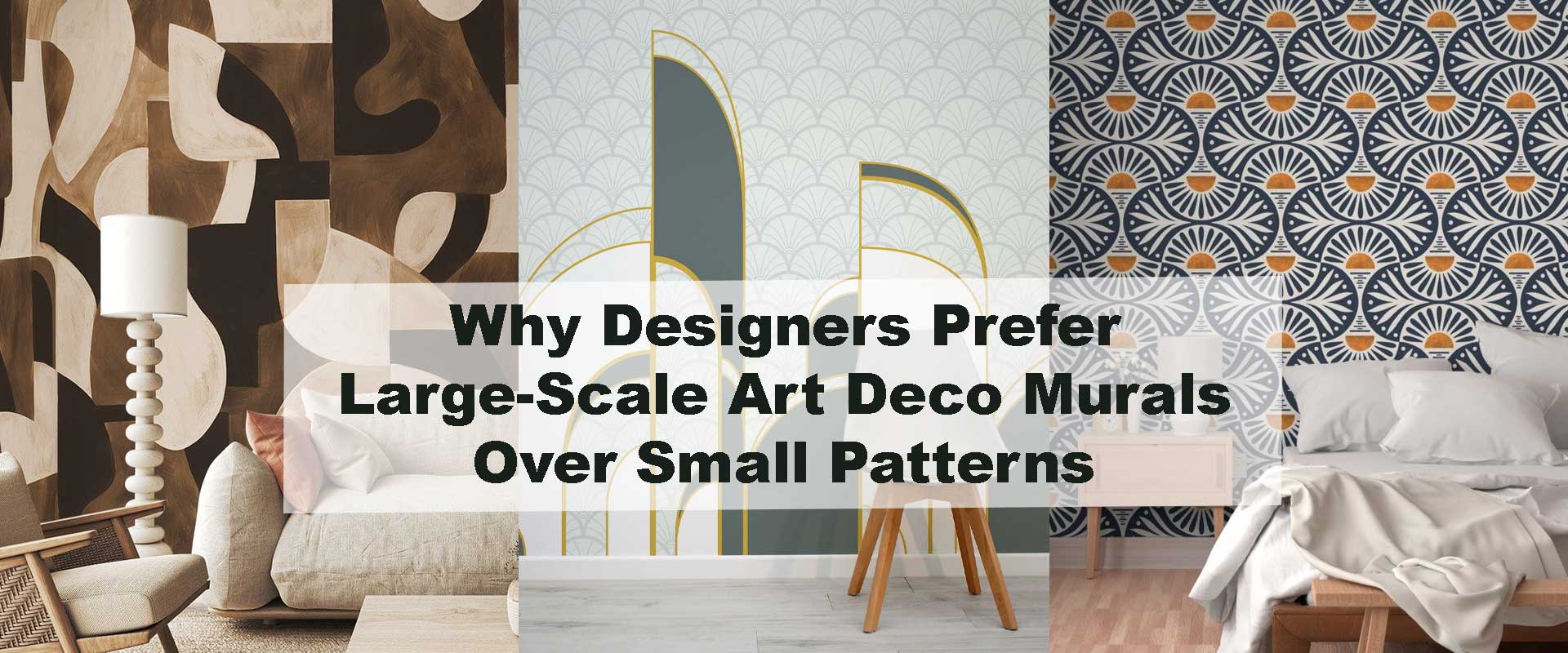
Bold walls are no longer an accent—they are the architecture of modern luxury interiors. Across high-end homes, boutique hotels, and curated apartments, designers are increasingly choosing large-scale Art Deco murals instead of repetitive small patterns. This shift is not about trend alone; it reflects how people experience space, light, and emotional impact. Large-format Deco designs create drama, clarity, and cohesion that smaller motifs often struggle to achieve. When scale, symmetry, and structure align, walls stop decorating rooms and start defining them.
The Psychological Power of Scale in Interior Design
Large-scale Art Deco murals instantly command attention because the human eye naturally responds to expansive visual rhythm. Instead of scanning dozens of repeating motifs, the gaze settles into a single, confident composition. This creates calm, order, and a sense of intentional design rather than surface-level decoration.
Small patterns can feel busy, especially in contemporary interiors where furniture lines are clean and open. In contrast, large Deco murals bring focus and hierarchy, allowing the room to feel composed rather than crowded. This is one of the core reasons designers lean toward mural-scale treatments when shaping sophisticated spaces.
Art Deco Was Always Meant to Be Architectural
Art Deco originated as an architectural movement, not a decorative one. Its geometry, symmetry, and metallic detailing were designed to work at scale—across facades, lobbies, ballrooms, and grand interiors. When reduced to tiny repeating patterns, much of that architectural intent is lost.
Large-scale murals restore Deco’s original purpose. Oversized arches, sunbursts, fan motifs, and stepped forms feel structural, almost built into the wall itself. This approach aligns naturally with curated collections like Art Deco Wallpaper, where design reads as form and structure rather than ornament.
Why Small Patterns Often Feel Visually Noisy
Small Art Deco patterns repeat rapidly, which can create visual tension over time. While they may feel charming at first, constant repetition can overwhelm the eye, especially in rooms meant for rest or long stays. Designers working on luxury interiors prioritize longevity, not novelty.
Large murals reduce repetition and introduce breathing space. The wall becomes a backdrop with rhythm, not a surface demanding constant attention. This subtle restraint is why upscale interiors increasingly avoid small-scale Deco prints.
Murals Make Spaces Feel Larger, Not Smaller
Contrary to old design myths, large-scale murals often make rooms feel more expansive. Broad lines and sweeping geometry lead the eye across the space, creating depth and visual flow. Small patterns, by contrast, can fragment walls and visually compress rooms.
Designers frequently use oversized line work and vertical geometry to enhance spatial perception, a concept closely tied to visual height and openness discussed in Are Art Deco Line-Pattern Walls Making Small Rooms Look Taller?. Large-scale Deco murals guide movement upward and outward, making even compact rooms feel intentional and grand.
Lighting Interacts Better With Large-Scale Designs
Lighting is where large-scale Art Deco murals reveal their full depth and sophistication. Expansive geometry allows metallic accents, marble-inspired veining, and sculptural lines to interact fluidly with both natural and artificial light. Gold detailing catches illumination softly rather than sharply, curved forms cast controlled shadows, and broad surfaces create a layered visual effect that feels dimensional instead of flat.
Small patterns often break light into fragments, scattering reflections in ways that can dull impact over time. Large murals behave differently—they absorb, reflect, and guide light with intention. Designs inspired by stone, metal, and architectural forms respond especially well to warm lighting, enhancing richness without glare. This is why designers frequently integrate large-scale Deco murals into carefully planned lighting schemes for living and dining spaces, where atmosphere matters as much as visibility.
Large Murals Create Instant Focal Points
In refined interiors, visual hierarchy is essential. Large-scale Art Deco murals naturally establish a focal point, giving the room a clear center of gravity without competing elements. One confident wall allows surrounding surfaces, furnishings, and materials to remain understated, creating balance rather than visual tension.
This effect is especially powerful behind sofas, beds, or dining tables, where the wall becomes an anchor rather than a backdrop. Small patterns rarely achieve this level of authority—they embellish, but they don’t lead. Murals, by contrast, define the room’s identity, allowing designers to build the entire palette, texture story, and material language around a single, intentional statement surface.
Material Illusion Feels More Authentic at Scale
Art Deco murals often mimic materials like marble, brass, onyx, or layered stone. These effects require space to feel believable. Large panels allow veining, gradients, and metallic lines to unfold naturally, creating depth that small repeats cannot replicate.
This is why designers gravitate toward mural-scale options such as Marble Art Deco Wallpaper, where scale enhances realism. When material-inspired patterns are compressed into small repeats, they lose the organic flow that makes them feel luxurious.
Modern Minimalism Pairs Better With Bold Scale
Today’s interiors favor fewer elements with stronger impact. Large-scale Art Deco murals align perfectly with minimalist furniture, neutral palettes, and open layouts. The wall provides richness while furnishings remain understated.
Small patterns often clash with modern minimalism, adding unnecessary texture and visual noise. Designers prefer murals because they respect negative space and allow furniture silhouettes to remain clear and expressive.
Customization and Exclusivity Matter More Than Ever
Large-scale murals feel bespoke. Even when repeated in different homes, they carry a sense of customization because the full composition is visible. Small patterns feel mass-produced by comparison, regardless of quality.
This sense of exclusivity connects strongly with the renewed interest explored in Why Art Deco Wallpaper Is Returning as the Biggest Luxury Design Trend. Designers are not just decorating rooms; they are curating experiences that feel intentional, rare, and refined.
Better Flow Across Open-Plan Interiors
Open-plan interiors demand visual continuity, not interruption. Large-scale Art Deco murals naturally guide the eye across expansive layouts, helping define zones without relying on physical dividers or abrupt material changes. Instead of breaking the space into fragments, a mural creates a visual pathway—anchoring a seating area, framing a dining zone, or subtly transitioning toward adjoining spaces.
Small patterns struggle in open layouts because repetition amplifies visual noise across wide surfaces. What feels decorative on one wall quickly becomes overwhelming when extended. Designers favor murals because they maintain cohesion across large spans, allowing the space to feel unified, intentional, and calm rather than busy. In generous living and dining areas, this restraint is what keeps the design sophisticated.
Statement Walls Age More Gracefully
Timeless interiors are built on proportion, balance, and structure—qualities that large-scale Art Deco murals embody naturally. Rather than relying on trend-driven motifs or decorative novelty, murals draw strength from architectural geometry, contrast, and rhythm. These elements remain visually compelling long after design trends evolve.
Designers think in decades, not seasons. A bold Deco mural continues to feel deliberate and refined because it behaves like a permanent design feature rather than a surface treatment. Small repeating patterns, by comparison, often reveal their era too clearly, making them more susceptible to feeling dated as styles shift.
When Designers Still Use Small Patterns
Small Art Deco patterns haven’t disappeared; their role has simply become more selective. Designers may choose them for transitional zones, intimate corners, or compact spaces where closeness and detail enhance the experience. In these settings, repetition can feel cozy rather than overwhelming.
However, in primary living areas, bedrooms, and feature walls, scale becomes essential. Large murals consistently outperform because they support the room’s architecture rather than compete with it. The distinction isn’t about preference—it’s about purpose. Murals shape space and atmosphere, while small patterns decorate surfaces.
Choosing the Right Art Deco Mural Style
Not all large-scale murals feel the same. Some emphasize geometry, others highlight texture, and some focus on color depth. Designers select styles based on mood and function.
Bold symmetry works beautifully in formal spaces, while softer gradients suit relaxed environments. Options like Geometric Art Deco Wallpaper offer structure and rhythm, while textured finishes add warmth without visual clutter.
Final Thoughts on Scale and Sophistication
Large-scale Art Deco murals are not just a design preference; they are a response to how modern spaces are lived in and experienced. They offer clarity over clutter, structure over repetition, and atmosphere over ornament. By honoring Deco’s architectural roots and adapting them to contemporary interiors, designers create spaces that feel confident, curated, and enduring.