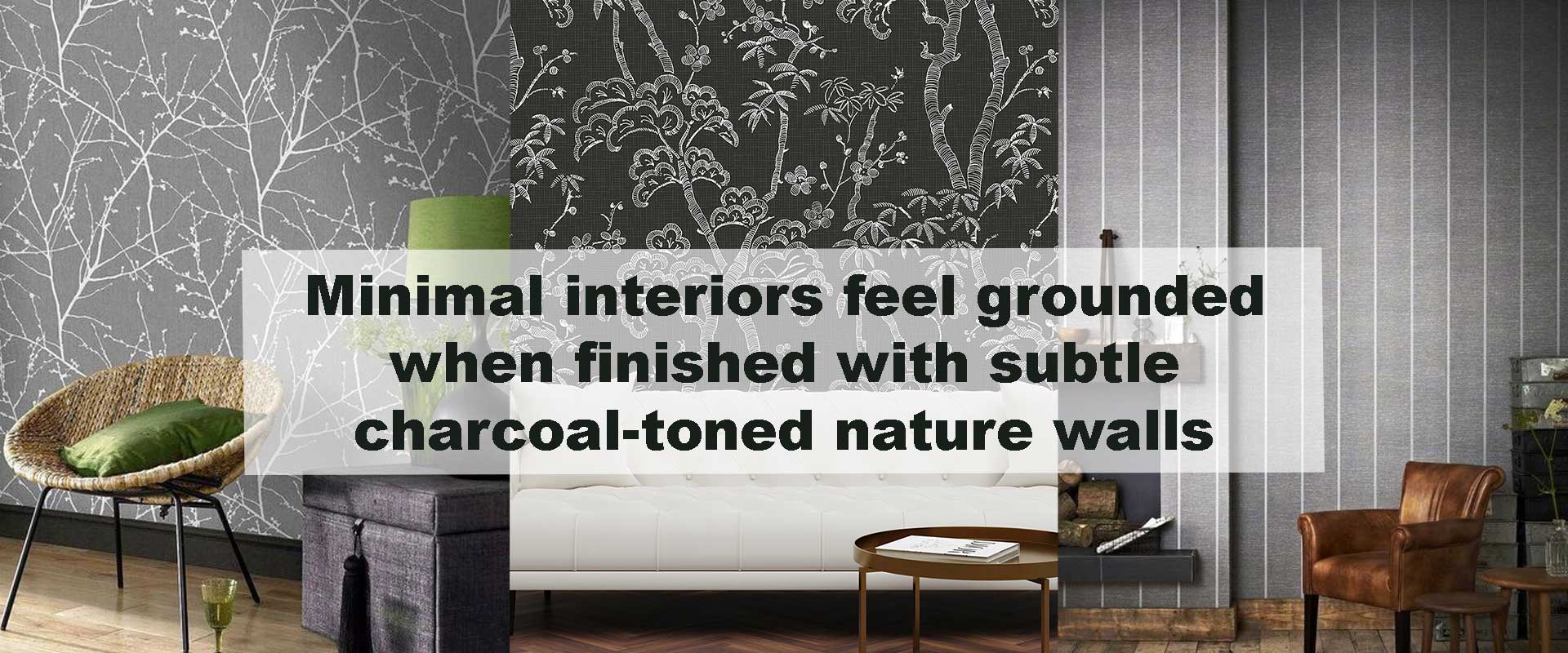
Minimal interiors feel grounded when finished with subtle charcoal-toned nature walls
Minimal interiors rely on restraint, balance, and intentional space. While clean lines and neutral palettes create clarity, they can sometimes feel visually unanchored once decorative layers are removed. Subtle charcoal-toned nature walls solve this quietly. Instead of adding contrast through color or ornament, they introduce depth, atmosphere, and grounding weight—without breaking minimalist discipline.
Charcoal nature walls work because they sit between light and dark, structure and softness. Organic imagery adds emotional stability, while muted tones maintain visual calm. The result is an interior that feels composed, grounded, and complete rather than sparse or unfinished.
Why charcoal tones stabilize minimalist interiors
Charcoal tones absorb light gently, avoiding the sharp severity of black or the visual flatness of mid-gray. In minimal interiors, this softness creates a sense of visual gravity that quietly holds the space together. Walls feel intentional rather than empty, giving furniture, negative space, and architectural lines something to visually settle against.
When nature imagery is layered into charcoal tones—misty forests, distant mountains, softened horizons—it introduces organic rhythm into otherwise linear environments. This contrast between natural flow and architectural order helps minimalist rooms feel emotionally balanced rather than overly clinical. The shift aligns closely with ideas explored in Why are nature murals replacing framed landscape artwork in contemporary interiors?, where immersive surfaces create deeper spatial connection than isolated wall décor.
How charcoal-toned nature walls act as visual anchors
Minimal interiors benefit most from a single, stable focal surface instead of multiple accents competing for attention. Charcoal-toned nature walls anchor the room without demanding focus. Their depth draws the eye slowly, allowing the space to feel centered, calm, and visually resolved.
Unlike bold feature walls, charcoal tones recede slightly, preventing visual dominance. Nature scenes built through texture, shadow, and tonal layering hold interest quietly, helping large minimalist rooms feel grounded while allowing smaller spaces to remain composed. Designers often rely on immersive surfaces from Nature wallpaper to achieve this sense of balance without cluttering walls with artwork or accessories.
Color harmony with minimalist palettes
Charcoal nature walls integrate seamlessly with minimalist palettes built around whites, warm beiges, pale woods, and soft stone hues. Rather than introducing contrast, charcoal deepens the existing color story, creating tonal continuity across floors, furnishings, and surfaces.
This harmony prevents interiors from feeling fragmented. Light flooring, natural textiles, and matte finishes appear sharper against charcoal imagery while remaining visually calm. The effect reflects principles discussed in Which kind of nature wallpaper maintains visual balance with bold furniture colors?, where cohesion and restraint guide long-term visual comfort.
Forest, landscape, and mountain imagery in charcoal tones
Certain nature themes amplify the grounding quality of charcoal palettes. Forest imagery introduces vertical rhythm that mirrors minimalist architecture, making Forest nature wallpaper especially effective in calm, structured interiors. Tree forms add movement without disrupting order, reinforcing a sense of quiet stability.
Landscape compositions soften space horizontally, subtly expanding rooms without overwhelming them. Distant hills, misty valleys, and layered terrain offer depth without visual noise. Mountain scenes rendered in charcoal tones add permanence and scale, aligning naturally with minimalist ideals—particularly through Mountain nature wallpaper, where strength, restraint, and atmosphere coexist.
Charcoal nature walls vs other minimalist wall finishes
| Wall Finish Type | Visual Impact | Emotional Effect | Best Use in Minimal Interiors |
|---|---|---|---|
| Solid white walls | Clean, open | Calm but can feel empty | Small spaces needing brightness |
| Flat gray paint | Neutral, uniform | Stable but flat | Transitional minimalist spaces |
| Solid dark walls | Bold, dramatic | Heavy, sometimes tense | Accent walls only |
| Textured plaster | Organic, tactile | Warm and grounded | Material-focused interiors |
| Charcoal-toned nature walls | Deep, layered, subtle | Calm, grounded, emotionally balanced | Feature walls in refined minimal interiors |
Emotional grounding through nature imagery
Minimal interiors are often praised for visual clarity, yet that same restraint can sometimes strip away emotional softness. Charcoal-toned nature walls gently restore this balance by drawing on visual cues the mind instinctively associates with stability—stone formations, shadowed forests, weathered terrain, and distant horizons softened by atmosphere. These references anchor the space emotionally without introducing distraction or ornament.
Because charcoal imagery is muted and layered rather than high-contrast, it slows visual processing. The eye settles instead of scanning, allowing the nervous system to relax almost subconsciously. Rather than pulling attention forward, these walls encourage stillness, making interiors feel restorative and grounded. This calming influence mirrors the emotional response explored in Nature wall mural scenes of lakeside sunrises slow the pace of busy primary bedrooms, where softened natural imagery shapes mood through quiet visual rhythm.
Light interaction and spatial depth
Charcoal-toned nature walls respond to light with nuance rather than intensity. Instead of absorbing illumination fully, layered imagery diffuses light across gradients, textures, and tonal transitions. This creates subtle depth that shifts throughout the day, preventing walls from feeling static or heavy.
In daylight-rich interiors, charcoal surfaces gain dimension as shadows and highlights reveal landscape contours and organic movement. As evening light softens, the same walls take on a cocooning quality, enhancing warmth without enclosing the space. In rooms with lower natural light, selecting lighter charcoal interpretations from Landscape nature wallpaper collections maintains visual balance, allowing depth to emerge without compromising brightness.
Furniture and material pairing
Minimalist furniture relies on proportion and silhouette rather than decoration, and charcoal nature walls support this philosophy effortlessly. Low-profile seating, pale upholstery, and streamlined forms appear sharper and more intentional against a textured charcoal backdrop, gaining definition without contrast-driven tension.
Natural materials benefit even more from this pairing. Stone, concrete, linen, and raw timber echo the organic qualities of charcoal nature imagery, reinforcing cohesion across surfaces. Instead of layering décor for interest, the wall itself provides depth and atmosphere, allowing furnishings to remain sparse, functional, and visually calm.
Abstract charcoal nature for ultra-minimal spaces
For interiors that lean toward extreme minimalism, abstract charcoal nature designs offer grounding without literal representation. Soft tonal gradients, blurred terrain, and atmospheric movement suggest natural environments rather than depict them, preserving abstraction while adding emotional weight.
This restrained interpretation keeps walls visually quiet yet expressive, ensuring they support space rather than define it overtly. The emphasis on mood over imagery aligns with emerging preferences highlighted in What scenic theme in nature murals is most in demand for 2026 living rooms?, where atmosphere, texture, and tonal depth are increasingly valued over realism.
FAQ
Do charcoal nature walls make minimalist rooms feel smaller?
No. When imagery is soft and layered, charcoal tones add depth rather than enclosure, often making rooms feel more expansive.
Are charcoal-toned nature walls too dark for bright minimalist interiors?
Not at all. They balance brightness by grounding light spaces, especially when paired with pale floors and natural materials.
Which nature themes work best with minimalist furniture?
Forests, distant landscapes, mountains, and abstract nature compositions complement clean silhouettes without visual conflict.
Can charcoal nature walls replace artwork in minimal interiors?
Yes. They often eliminate the need for framed art by becoming the primary visual element themselves.
Do charcoal nature walls age well over time?
Their neutral tone and timeless nature themes make them highly adaptable as furnishings and styles evolve.
Conclusion
Minimal interiors feel most grounded when visual depth meets restraint. Subtle charcoal-toned nature walls deliver this balance effortlessly, offering emotional stability, tonal richness, and architectural calm without excess. They anchor space, enhance material relationships, and support long-term design relevance.
By choosing charcoal nature imagery thoughtfully, minimalist interiors gain warmth and permanence while preserving clarity. The result is a space that feels intentional, calm, and quietly connected to nature—an environment that supports stillness rather than distraction.